
Canada enters a technical recession for the first time since the COVID pandemic in 2020: What does this mean for the Bank of Canada and mortgage rate forecast?
Canada’s Huge GDP Miss
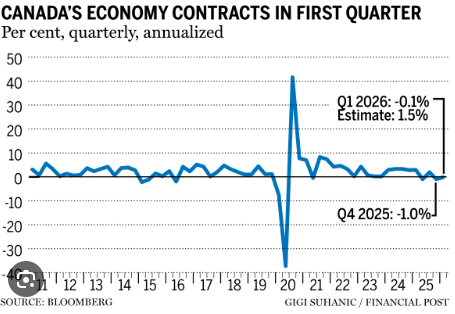
GDP in Q1 2026 declined 0.1%, broadly missing the Bank of Canada’s and market estimates of 1.5% growth. This comes on the heels of a 1% contraction in GDP in Q4 2025, meeting the technical definition of a recession with 2 straight quarters of economic decline.
The major 1.5% miss on growth calls into question the reliability of the Bank of Canada’s estimates and likely weakens the BoC’s case for a 2026 hike.
When economic growth is lower, this has downward pressure on inflation and reduces the chances of a BoC rate hike.
With this said, financial markets still forecast that the BoC will hike once in December 2026, and then again in 2027
Why does the market continue to forecast a hike in 2026 and hikes in 2027?
Although the Q1 GDP number qualified as a technical recession, for practical purposes, the 0.1% decline is widely considered flat among economists.
Moreover, the preliminary reading for April GDP growth came in at 0.4% – the strongest since January 2025, resulting in a strong consensus among analysts, including Capital Economics, that the downturn is ‘certain to already be over.’
So there is no imminent threat of a spiralling GDP in Canada, even though growth is certainly soft. This near term ‘floor’ on Canadian economic growth could allow for higher inflation and the need for the BoC to hike rates to contain it.
Moreover, as oil prices remain above $90, as a primary economic input cost, this is projected to pass through or seep into broader economic pricing, causing broader inflation in core goods and services, not just contained to energy and prices.
The problem is, once inflation is broadly triggered, it tends to take on a life of its own. Because prices are rising faster, consumers tend to purchase more, sooner, to avoid higher prices later. This is known as an increase in monetary ‘velocity’, and it further perpetuates inflation. Then, employers and unions are pressured to raise salaries to match the higher inflation rate, which further pushes prices higher, resulting in a vicious inflationary cycle.
The only weapon the Bank of Canada has against this vicious cycle is its overnight policy interest rate. By increasing the rate, they ‘suck money’ out of the economy, thereby reducing demand for goods and services, and keeping price inflation in line.
How does this affect the mortgage rate forecast in Canada?
The inflationary impulse has a direct impact on the mortgage rate forecast: Variable mortgage rates increase directly with the BoC overnight rate, and fixed rates move higher well in advance, in line with Government of Canada bond yields.
Yes, raising rates is a brutal approach and terrible for economic growth, especially in an already soft economy. But it’s either this or risk losing control over increasing prices.
This is what the market is considering when it projects that higher oil prices will pass through the economy.
What would prevent the BoC from increasing rates?
Even though the Canadian economy is soft, which should help the BoC hold off on a rate hike for as long as possible, oil prices are still in charge.
Lower oil prices as a result of a de-escalation of the Iranian war is the primary catalyst for lower inflation and lower mortgage rates.
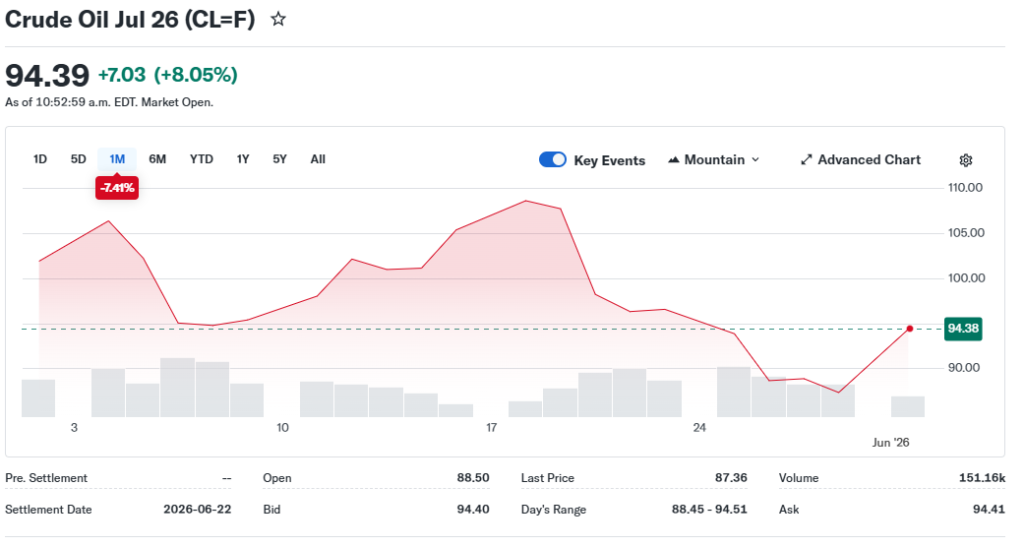
As of Monday, June 1, oil prices are already lower at $94 per barrel – down from recent highs of $112 – but still in lofty territory (and significantly higher on the day).
Oil prices trending lower are a result of ongoing negotiations or attempts to reach a deal to end the war in Iran. When a deal is struck with Iran, we’re likely to see oil prices plummet into the $70 range, which is not nearly as inflationary.
Regarding the timing of such a move, US mid term elections are November 3 2026, so in the fiercely driven self-interest of US politicians currently in power, they would need to show lower inflation well before this – likely within the next 1-3 months.
If we assume oil prices will drop to and remain in the $70 range (or even the low $80 range) within the next 1-3 months, this would materially change the data for rate increases and would be supportive of a BoC rate hold through 2026 and 2027.
Moreover, if Canada’s economic growth continues to weaken due to US trade friction or economic policy failures, we would see additional downward pressure on rates.
Given the fluidity of the Iranian war and ongoing negotiations, I see it as likely that the Bank of Canada will hold through 2026, even if oil prices remain close to $90 per barrel. I see the Bank of Canada holding off on hiking rates as long as possible to allow for a reduction in oil prices. Finally, I see the 2026 window as enough time for the US and Iran to strike a deal that results in lower oil prices.
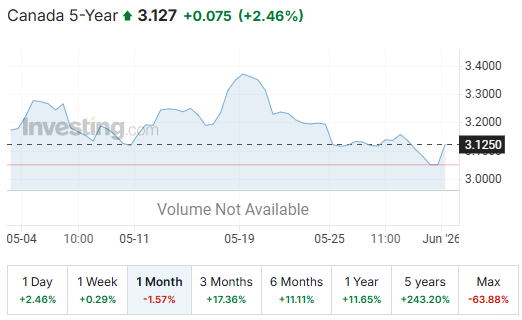
Bond markets are already factoring in this reality, with the 5 year bond yield down about 8% from its recent high. This forward-looking measure is trending in the right direction and greatly reduces upward pressure on fixed rates.
Although there is a possibility of a random negative turn of events that send oil prices higher, I see it more aligned with self-interested mega power centers, for oil prices to drop, and likely that this trend continues downwards, thereby placing neutral, if not downward, pressure on fixed and variable mortgage rates mid – late 2026.
Smith Manuever Tip of the Week
When implementing the Smith Maneuver, a core best practice is to rely on long-term, high-quality data to project future results. Although there is no guarantee for the future, the more stable the data we rely on, the higher the likelihood of success.
A perfect data backed example is Index Fund/ ETF investing. We can see that over the past 100 years, the S&P 500 has achieved a 9%+ return. This is through multiple severe recessions and major marjet drawdowns, various bubbles and hyped up market strategies that have come and gone.
Buying and holding a simple S&P 500 index has proven to be an excellent wealth compounder and a reliable long-term wealth-building tool.
This same thinking can be applied to the Smith Maneuver. By creating a long term Smith Maneuver foundation of simplicity and reliability, this adds confidence to the strategy and improves the likelihood of success. If you believe the markets will continue to grow over time, then by applying this thinking, you believe in Smith Maneuver sucess.
On the other hand, picking stocks around themes like dividend investing and technology investing introduces risk to the strategy. Trading stocks within the strategy entails substantially greater risk for crystallized losses.
By keeping the investment strategy simple, data-driven and evidence based – this increases your chance of success – even if long term future returns end up lower in the 6% – 7% range. You should still fare well with the strategy by keeping focused and consistent.
