
Canada’s labour market came back to life in May, adding 88,000 jobs and exceeding market expectations of 10k jobs. Gains were broad based, meaning they were full time and spread across industries.
This allows Prime Minister Mark Carney to take a breath on the heels of recent recessionary headlines, but the implications for mortgage rates are less reassuring.
To cut through all the noise and see what the job numbers mean for Canadians, we go straight to Bond Yields. The 5 year bond yield popped about 0.10% on the news, which adds slight upward pressure to fixed rates.
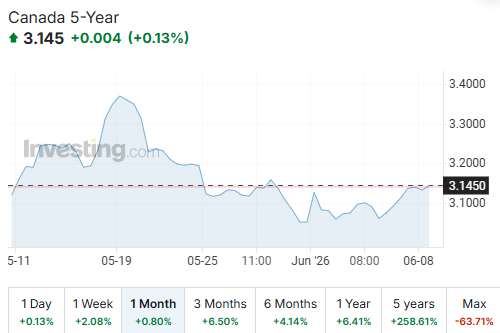
The reason for the increase in bond yields is that stronger employment increases the likelihood that Canada will exit its technical recession in April and reduces the need for the Bank of Canada to lower rates to stimulate the economy.
In fact, a stronger jobs market promotes spending strength in the economy, which adds pricing pressure, or in other words, inflation.
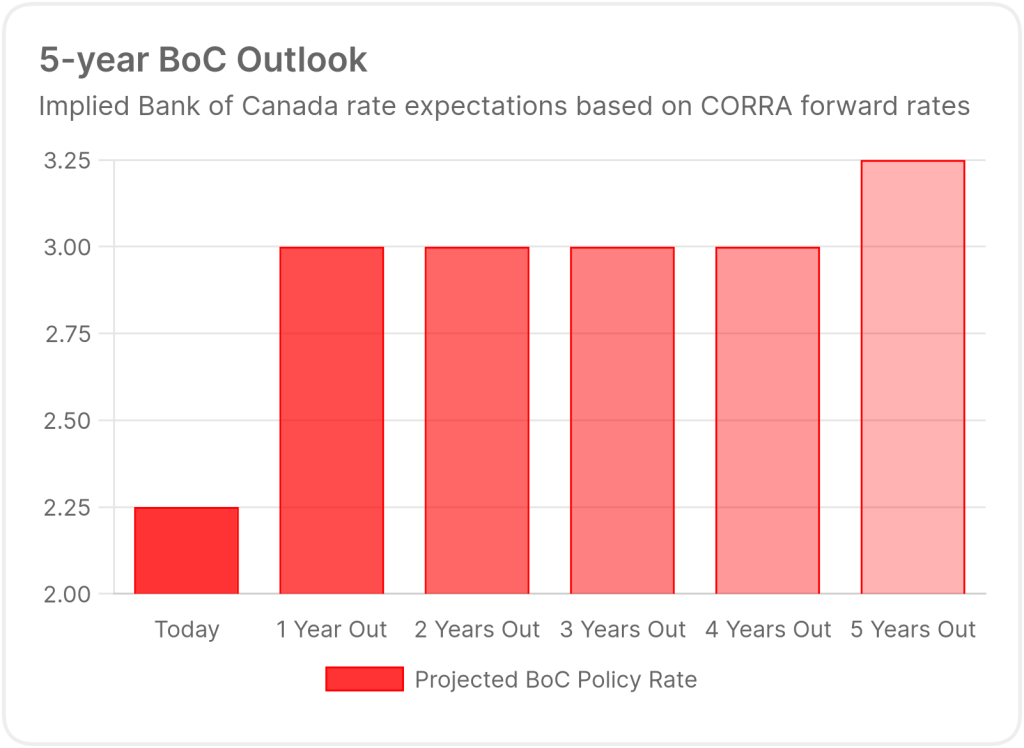
This inflationary impulse from job gains adds credibility for BoC rate hikes later in 2026 and into 2027.
More specifically, bond yields and financial markets currently imply 1% in Bank of Canada rate hikes over the next 5 years. Although much can (and will) change over this time, this is sound probability based on current data.
The Bank of Canada’s June Decision
As the Bank of Canada is set to meet on Wednesday, June 10, the likely result is a ‘hawkish hold’ meaning that the BoC will not raise rates in June, but will likely refer to increasing pricing pressures as a result of high oil prices and that Canada’s economy won’t be immune to these inflationary pressures.
In other words, the Bank of Canada will likely refrain from committing to hikes any time soon, but will suggest that a hike may be on the table given the current economic trajectory.
Oil Prices, US economics and Trade Weighing on the Bank of Canada
Last week’s employment data won’t be the only thing weighing on this week’s BoC decision and bond yields/ fixed mortgage rates/
The Iran war peace talks have taken another step backwards with new attacks and instability in the region. This continued conflict will keep oil prices high, and as inventories continue to run dangerously low, threaten significantly higher oil prices in the weeks to come.
There is a time limit for oil at $90-$100 per barrel, and if the war is not de-escalated soon, we could see another leg up in oil prices and bond yields, along with a pop in fixed mortgage rates.
If this scenario plays out and holds through the summer, we would likely see the Bank of Canada talk of an imminent rate hike, affecting variable mortgage rate holds.
US Economic Influence
The US economy also revealed a major surprise spike in employment, reducing the likelihood of a rate cut in the US and sending its bond/treasury yields higher.
Because US economic strength affects Canada and Canadian bonds tend to be priced relative to their US counterparts, US strength also adds upward pressure on Canadian fixed mortgage rates.
CUSMA Trade Impact
The CUSMA trade talks will likely negatively affect the Canadian economy and employment, and the Bank of Canada is unlikely to hike rates until the negotiations are largely complete.
Even if there is a reasonably similar deal to the current CUSMA, the US, as it attempts to extract trade concessions from Canada, will likely threaten major economic penalties.
These potential threats are likely to lead consumers and corporations to be more cautious in their spending and investment. So the intensity of the negotiation is likely to have as much, if not more, effect than the eventual outcome, and the Bank of Canada will be factoring this in significantly.
Variable Mortgage Rate Word of Caution
In this environment, it can make a lot of sense to take a variable rate:
- There is a 0.50 – 0.75% diffrence from the 5 year fixed mortgage rate counterpart.
- If oil prices drop to $70 – $80 range, it’s likely that inflation cools enough to thwart oil price increases.
- In the short term, the Canadian economy is soft, with Canadians feeling the economic pinch on the ground level, despite the strong May Jobs numbers.
- Long term, there are several deflationary pressures that influence AI driven productivity advancement
- The lower variable rate will allow for some degree of savings in the near term, ahead of a BoC increase, thereby buttering
This has many homeowners flocking to variable-rate mortgages.
However, this is just what the Banks want right now, and could end up benefiting the Banks much more than a variable rate could benefit homeowners in the short term:
- As variable rates increase, the banks increase their Bank Account savings rates more slowly, creating a highly profitable ‘spread’ for banks.
- As many variable rate holders lock in to fixed rates, these variable rate holders will not receive the same kind of highly discounted fixed rates as they would receive on a standard application (on purchase or renewal). Typically, banks add a 0.20-0.25% premium to variable rate lock-ins. Its either pay up, or switch to a different bank and pay the 3 month interest penalty.
Choosing a variable rate should be a long term strategy, with the understanding that short term volatility and hikes are a definite possibility.
Smith Manoeuvre Tip of the Week
The Smith Manoeuvre, when implemented properly and for the long term, can be a life-changing strategy, potentially adding hundreds of thousands to net worth.
But it is still just one piece of the puzzle, forming one part of a broader financial plan. The Smith Manoeuvre should be seen in the context of other retirement funding sources, including pensions and registered savings.
By planning a multifaceted, comprehensive plan that includes the Smith Manoeuvre, efficiencies and improvements can be achieved, and it becomes easier to implement and follow the plan through to fruition. This improves net worth, motivates you to stay on track, and provides peace of mind that you’ll reach your goals.
