
Financial markets and economists are currently divided on whether the Bank of Canada will hike its overnight rate in 2026. Here, we analyze both sides of the story: why financial markets are forecasting rate hikes, while the consensus of economists forecasts a BoC hold in 2026. We’ll also look at how to protect yourself from risk if you currently have or are considering a variable mortgage rate.
Market Data
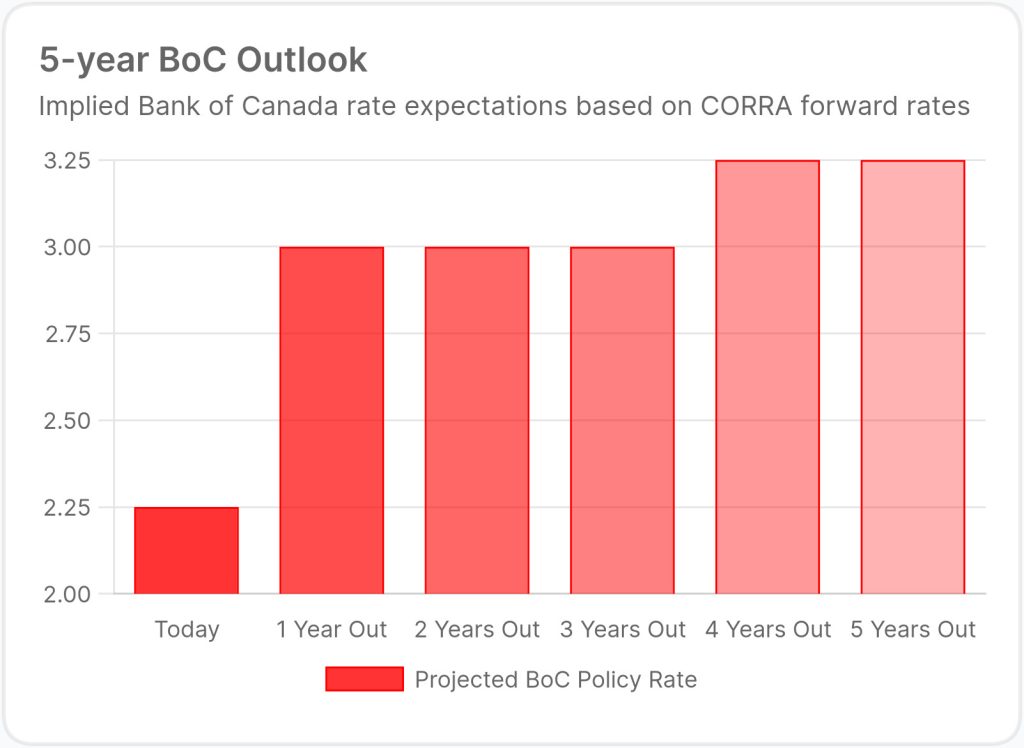
The Bank of Canada will hike its overnight interest rate by 0.25 – 0.50% in 2026 based on financial (‘betting’) markets/ bond yield data.
Specifically, market data currently show a 63% chance of a BoC rate hike at the September 2026 meeting, and this probability spikes, approaching the second-hike threshold, through the remainder of 2026.
Importantly, market projections closely reflect odds on the opening of the Strait of Hormuz, which is not projected to substantially re open until at least August 2026 – which allows for enough time for oil reserves to deplete further, keeping prices high. This would allow enough time for high oil prices to be baked into the rest of the economy as a key input.
Economist and Big Bank Rate Forecasts
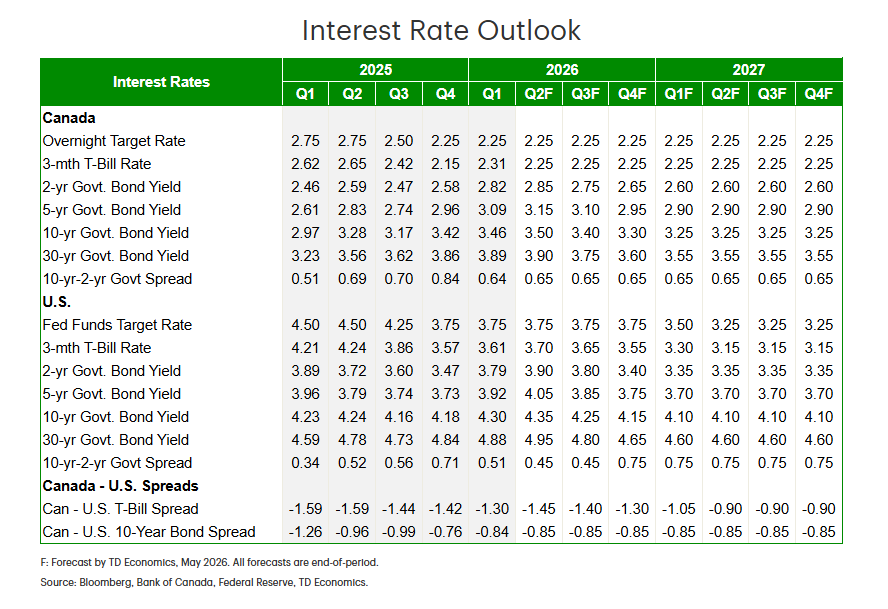
However, major bank economists are more divided, with RBC, TD, CIBC, BMO expecting a hold, with Scotia and National aligning with market forecasts.
Even though financial markets believe there will be hikes in 2026, the environment and odds can change fast – very fast. In a single day or over a weekend, major developments could break, sending oil prices down and tempering inflation expectations.
Moreover, the Bank of Canada does not take orders from the financial market ‘gods’. The Bank can decide to hold longer, even if inflation persists.
One key variable to watch is core inflation. While headline inflation includes energy/gas prices, core inflation does not. Core inflation represents prices across the economy, excluding food and energy costs.
This is important because core inflation shows broader-based, more fundamental inflation. The Bank of Canada will not likely hike rates unless there is a sharp increase in core inflation. This could happen, as oil is a key economic input – meaning many core goods are affected by oil prices.
If we see core inflation increase by 0.50-1%, the Bank of Canada will likely begin discussing a rate hike. But this could reasonably take another 2-3 months until the end of the summer, which – again – assumes no significant resolution for the Iranian war.
Also, Canada is already in a soft economic environment. Specifically, GDP and employment are weak. The main purpose of a rate hike is to reduce spending, lower demand for goods and services, and therefore moderate prices. But if a soft GDP and employment are already serving this function, the Bank of Canada’s job is likely already half done.
Finally, the Bank of Canada is less likely to increase rates unless the US increases. While the US Federal Reserve is currently embattled in a tug of war for a rate cut over the coming months, the likelihood of a hike is extremely slim – even if core inflation increases moderately.
Which do you think the BoC will do in 2026?
Variable Mortgage Rate Demand is Surging
Canadian mortgage shoppers are placing their bets as market demand for variable-rate mortgages is surging.
This is logical given an approximate 0.50% gap between fixed and variable rates. In other words, the Bank of Canada would need to hike rates by 0.50% in order for variable rates to match fixed rates.
On a side note, I would argue the psychological effect of a 0.50% BoC hike would be significant in tapering consumer purchasing behaviours, especially for major purchases and discretionary spending, resulting in lower inflationary pressures.
As this is happening, there would have to be no significant resolution to the Iranian war, and specifically the reopening of the Strait of Hormuz, well into 2027.
Even though the markets are currently projecting this could be the case, there is significant political pressure weighing on a resolution in the very short term (i.e., midterm elections in the US) and the medium term (US presidential elections).
Implement a Solid Mortgage Rate Battle Plan
If youre a Canadian mortgage shopper planning on a variable rate, it makes sense to protect from upside risk. This can be done by increasing your everyday mortgage payment to the equivalent of a 0.50% higher fixed rate mortgage
For example, if your variable rate is currently 3.6%, consider using pre payments to reflect a 4.1% fixed rate: Every penny of the pre payment will pay your principal down faster, and if variable rates increase later in 2026, you could cancel the pre payments.
If youre considering a variable rate, be sure to reserve your rate soon. As the demand increases for variable, banks could start reducing the ‘prime minus’ discount or ‘spread,’ resulting in a lower differential between fixed and variable rates.
Smith Maneuver Tip of the Week
One of the key concerns with the Smith Maneuver is whether the CRA will review, and if they do, will your books be secure?
When implementing the Smith Maneuver, the key is to trace all transactions. Have a spreadsheet available that allows you to track the exact details of:
- How much the HELOC increased in the month
- How much was transferred to the investment account
- How much HELOC interest was charged in the month
- A running total for these things
At tax time, these entries should add up to the statements you receive from your mortgage lender, reflecting the total mortgage interest paid in the year, and your investment broker (e.g., Questrade or Wealthsimple). If your recoded data reconciles with the institutional data, you’re safe. If not, you will need to investigate the cause of the difference.
Recording these transactions takes just 5 -10 minutes per month and makes a world of difference if you decide to pursue this potentially life-changing financial strategy.
