
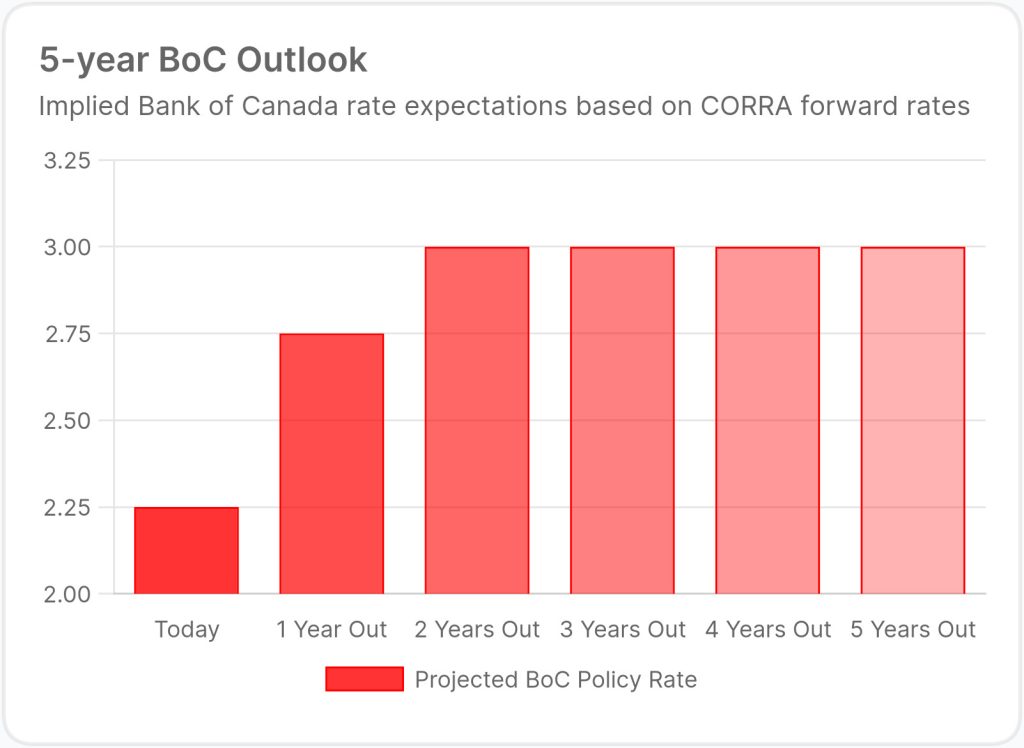
The Bank of Canada held rates at its June 2026 meeting, as widely expected. In fact, the majority of economists and financial markets expect the Central Bank to hold for the next few meetings. However, come December 2026, this is where things could get interesting, as financial markets/OIS markets are projecting a 70% chance of a rate hike. Will a hike actually happen?
Let’s review commentary from BoC Governor Tiff Macklem and developments in the Middle East to assess whether a 2026 rate hike is realistic.
What’s Bank of Canada Governor Tiff Macklem Trying to Tell Us (without actually saying it)?
The BoC statement accompanying its recent rate hold noted that further US tariffs and trade restrictions could require the Bank to cut its overnight interest rate further.
On the other hand, the statement went on to include that sustained oil-based inflation could encourage ‘consecutive increases’.
So they’re saying the rate could go either way, depending on how the sequence of events plays out and to what degree.
Importantly, there were changes in the wording – moving from a more neutral tone that high oil prices ‘warrant close attention’ to a more hawkish stance, committing ‘not to let higher energy prices become persistent inflation’. As the wording shifts in this direction over time, it’s as if the BoC is trying to tell us something without actually saying it.
This comes on the heels of a 0.25% interest rate hike by the European Central Bank (ECB) – for the exact same reason the BoC is starting to shift its stance – high oil prices – just a couple of steps ahead, given Europe’s greater reliance on Middle East oil and even higher gas prices.
Given the conceptual ‘tug of war’ at the BoC, between a soft Canadian economy and trade threats on one side, and inflationary oil prices on the other side, the rate forecast and market odds (that weigh these likelihoods) are currently still pointing to a 70% chance of hike in December 2026, however this number is down from over 80% last week – beore US-Iran took steps towards a peace deal.
Middle East Peace – But for How Long?
The war between US and Iran has pushed oil prices higher, causing global inflation to march upwards, and pressuring mortgage rates higher as a result.
Over the past weekend, the US and Iran tentatively agreed to a peace deal that could put pressure on inflation and mortgage rates in reverse. However, until the documents are signed, the ink is dry, and we see a commitment to peace efforts for at least a few weeks, the market remains cautiously optimistic.
We have yet to see how the Straight of Hormuz will be managed going forward, and much contention could arise in the coming days.
As noted, the market is weighing these odds and still places a significant likelihood that we’re not completely out of the woods on the war in Iran. In addition, even as the situation eases and oil prices reach the $70-$80 range, it will still take months for markets to stabilize and for disinflationary impulses to return. This means we’re likely to see a floor in fixed rates over the coming weeks, as the potential for a BoC hike in 2026 hinges on the outcome of Middle East peace discussions in the coming days.
Smith Manoeuvre Tip of the Week
The Smith Manoeuvre operates as a self-contained strategy that traditionally requires no additional mortgage payments or cash flow to benefit from it. Because the HELOC interest payments are paid or ‘recapitalized’ by the HELOC itself, homeowners do not need to make extra payments.
However, if the Bank of Canada were to increase its interest rate by 3% or more, this would risk a surge in HELOC interest costs (used primarily for investment borrowing). If interest were to surge, this would prevent continued investment purchases and cause interest on current borrowings to outstrip the newly available HELOC room (created by principal payments on the main mortgage) each month. In other words, the strategy would stall and require additional cash flow to operate.
Although a 3%+ rate hike by the BoC is highly unlikely, there should be a backup plan. Here are two backup plans to be aware of:
- Use invested capital to pay the interest. Since a high interest rate at over 5.25% is unlikely to be sustained, some investments could be used to cover the additional cash flow required to service the higher interest cost short-term.
- Have excess cash flow or a seperate emergency fund on standby. Understanding that you might have to dip into an emergency reserve or use income to service the strategy is part of a plan that covers all bases, even the unlikely.
