
The Bank of Canada meets on Wednesday, July 15, with financial markets currently pricing in a token 10% odds of a cut.
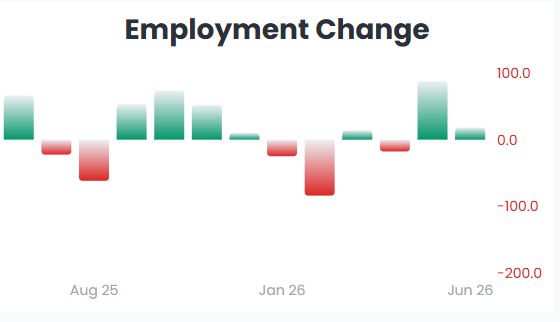
This comes on the heels of last week’s employment numbers release, which revealed a 0.1% decline in unemployment from 6.6% to 5.5% month over month. This gives the Bank of Canada no reason to cut – or hike rates over the coming months, leaving the markets at an undecided 50% odds for a cut by year’s end 2026.
How the market odds swing will largely depend on oil prices and, more specifically, on how prices affect inflation.
Markets may be undecided, but the consensus among top economists is that the BoC will hold through the year.
More below.
June Employment Numbers Canada
For months, the economists consensus has been that employment in Canada has been in trouble. However, it turns out the trouble may be with the economists themselves, as the jobs market has shown signs of stabilizing. This has led some economists to moderate their views on Canada’s employment for the remainder of 2026:
June’s 18,000 jobs gain pushed the unemployment rate down to 6.5%; however, Scotiabank Sr. Economist Derek Holt said that the 6.5% number is misleading and that Canada may already be at full employment:
“Measured using US concepts, Canada’s unemployment rate would be 5.1% instead of the official 6.5%,” he says, explaining that “The U.S. requires stricter evidence that one is searching for a job in order to count in the labour force.” Says Holt.
Moreover, wage growth accelerated to 3.7% in June.
TD Bank agrees, noting that ‘Canada’s 2026 employment trough is likely behind us’ and RBC also sees unemployment drifting lower in 2026.
The overall consensus is now a narrative of job stabilization – neither a jobs boom, nor a crash – which provides further support that the Bank of Canada will hold its overnight rate for the foreseeable future.
Accordingly, variable rate mortgage holders can remain cautiously optimistic for a stable rate through 2026, barring a major oil shock, as we will examine next.
The Iran War Flareup, Inflation and Mortgage Rates
The war in Iran seems to be stuck in a pattern of flare-ups and de-escalation. Stability in the region is paramount, as it directly affects oil prices, which in turn influence inflation, the primary determinant of the mortgage rate forecast.
What we see is that the US is not seeking a major escalation or regime change in Iran, which would likely push oil prices far past $100. Moreover, the framework for negotiating remains open through the attacks we’ve seen over the past few days. From here, the war either spirals out of control or attacks continue for a few more days, ending in a ceasefire.
At the highest political and economic levels, here are the reasons we likely see a ceasefire soon:
- Political power depends on low oil prices and inflation. If oil prices continue to increase into the US Midterm elections, this will substantially affect party power in the US.
- Along the same lines, the stock market will fluctuate wildly if there’s a sustained war with Iran, affecting trillions of dollars in assets.
- The AI revolution now accounts for 25% of US GDP growth and continues to accelerate. This revolution requires stability to continue its path, and this has a massive influence on politics.
- For the US (and Canada) to continue borrowing at preferred interest rates, stability must be maintained. Chronic instability in a key economic region threatens this stability and could send interest rates to critical levels. As much as this affects the government, it also affects the population’s access to borrowing, ie, mortgage rates.
For these reasons, bond and stock markets remain relatively calm. Although they are priced at a higher risk as seen in recent price movements, they are not anticipating a massive upset. We can’t talk in absolutes, only likelihoods, and it’s likely we will see the war continue to de-escalate and for markets to stabilize.
Ultimately, the longer the stabilization, the more favourable this is to lower mortgage rates.
Smith Manoeuvre Tip of the Week
One of the biggest questions regarding the Smith Manoeuvre is how to ‘de cumulate’ or sell the investments once it’s time to start taking the gains. Here are 3 key ways to sell the investment component of the Smith Manoeuvre while minimizing taxable gains:
- Plan for a period of lower income. This means retiring (ending or reducing employment income) and pushing off pensions while selling the non registered Smith Manoeuvre. This means that most, if not all, income is derived from these investment sales, and this keeps your marginal tax rate – and average income tax paid on these gains low.
- Use RRSP room. If you have unused RRSP room, purchasing RRSPs before age 71 can reduce the taxes paid on capital gains, allowing you to spread the gains over the remainder of your retirement and resulting in lower tax rates. Spreading out income in this way is key to efficient financial planning.
- Hold the strategy through retirement. The downside here is that the tax-deductible Smith Maneuver HELOC remains longer through retirement. However, it also provides greater opportunities for investments to grow. In this way, there’s a strong possibility for future gains, and you can withdraw the funds on an as-needed basis through retirement.
Visit our Smith Manoeuvre page for more.
