
Canada’s economy showed a little more life than expected in April.
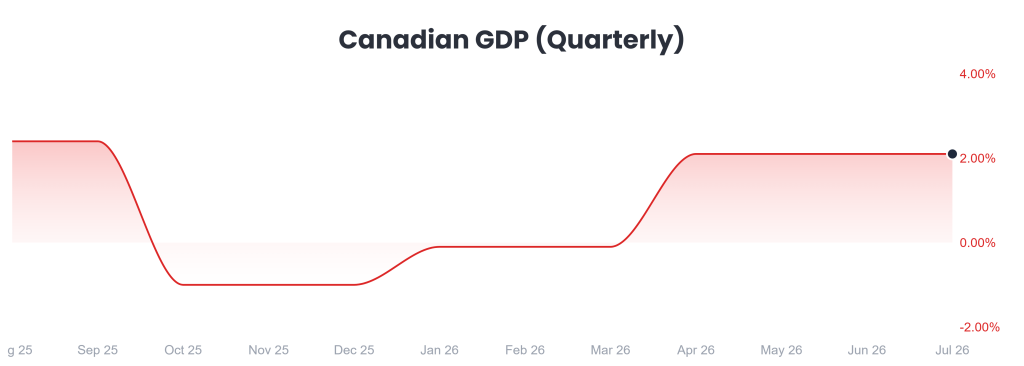
Real GDP rose 0.5%, slightly ahead of the financial markets 0.4% estimate, marking the strongest expansion since July 2025.
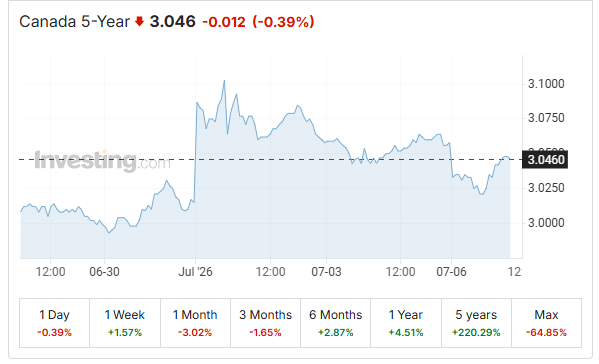
That was enough to pull Canada out of its technical recession and to firm up Canadian Bonds, with the 5-year holding just above 3%, and keeping fixed mortgage rates from dropping faster and more substantially. We’ll review this and an update of the short-term mortgage rate forecast in this week’s article.
GDP Improves – But Not by Much
The April GDP report was stronger than expected, but it was not the kind of growth that screams ‘growth’.
The recent strength came from goods-producing sectors, including mining, oil and gas, construction, and manufacturing. Services also grew, but more modestly.
Statistics Canada’s early estimate for May showed only a small 0.1% gain, which suggests the economy may be stabilizing rather than accelerating.
That is an important distinction. If growth were ripping higher, bond yields could rise, and relief on mortgage rates could be pushed further away.
But if growth is simply stabilizing after a weak stretch, the Bank of Canada can remain patient.
Why Fixed Rates Didn’t Fall More Last Week
Heading into the GDP report, there was growing anticipation that weaker Canadian data, softer inflation pressures, and lower oil prices would pull bond yields lower.
That would have opened the door to meaningful drops in fixed-rate mortgages. But the GDP report came in slightly better than expected.
At the same time, U.S. economic data remained firm enough to keep North American bond markets cautious.
That combination kept the 5-year bond yield hovering just over 3%.
The bond yield and fixed mortgage rate trend is still pointed lower, and we should start to see some small drops; however, the rate drops won’t be fast or in a straight line.
The Rate Trend Still Points Down
The longer-term pressure on inflation and fixed mortgage rates still appears to be easing. Here’s why:
Oil prices have pulled back sharply from their highs, currently trading in the $60 range. That matters because oil feeds into inflation, through gas prices, transportation and overall production costs.
Lower oil prices do not instantly solve inflation. But they do remove one of the major upside risks.
At the same time, the CUSMA trade situation remains important.
The North American free trade framework remains in place, but the US has declined to extend the agreement in its current form, meaning reviews and negotiations will continue.
That creates uncertainty and is a major headwind for investment in Canada and job growth.
This likely creates a net effect of lower inflation, and a greater need for the Bank of Canada to stimulate the economy through lower rates – or at least – by not increasing them.
What This Means for Homeowners
For variable-rate borrowers, the focus remains on the Bank of Canada. According to financial markets, there is close to a 50% chance that we’ll see a rate hike in 2026. However, the consensus among economists is that the Bank of Canada will hold in 2026.
I agree, the economy is not weak enough to force panic cuts, but it is also not strong enough to justify more tightening.
Along with a net negative effect from trade uncertainty, this keeps the door open for future rate cuts if inflation continues to cooperate.
For fixed-rate borrowers, the focus is on the 5-year bond yield.
Right now, the 5-year yield is still a little too firm for a major fixed-rate drop.
But with oil prices lower, inflation pressure easing, and growth still uneven, the broader trend remains more favourable than it was in early June, and its likely we’ll see slight downward movement, perhaps 0.10% – 0.20%, on fixed rates over in July.
Smith Manoeuvre Tip of the Week
Here are the top 3 risks involved with the Smith Manoeuvre, and how to reduce these risks:
Investment Risk
The risk that the investment component of the Smith Manoeuvre will fluctuate in the short term frightens some. This is reasonable, and the strategy should not be pursued with a lower tolerance for stock market volatility. However, over the long term of 10+ years, markets have proven to be reliable growth mechanisms. By committing to a long-term mindset and holding the course for 10-15 years, the risk of market losses is significantly reduced.
Also, by dollar cost averaging into the market over many months and years, you are not committing a single large investment at any one time – if the market dips, you buy the dips.
Interest Rate Risk
If interest rates increase by 3%+, the strategy won’t work as well because the interest cost on the HELOC component will be higher. However, it’s important to note that historically, when interest rates spike to tame inflation, these periods are short-lived. Once the higher rates work to reduce inflation, rates drop.
It’s also true that during periods of high inflation and rates, the value of the money owed (i.e., the debt) is being eroded by inflation, so you owe less in nominal dollar terms.
Finally, when rates are higher, so are your income tax deductions. Receiving higher income tax refunds reduces the risk.
The key is holding the course during interest rate fluctuations – they will be short-lived and mitigated by other factors as noted.
CRA Risk
If the strategy is not implemented properly and monthly transactions aren’t recorded, it can result in CRA costs and headaches.
But this is the easiest to avoid, because we have control over this outcome.
By ensuring proper implementation that follows CRA rules, and by recording detailed monthly transactions and reconciling them with the lender. investment statements – you will be well-positioned for success without CRA issues.
