
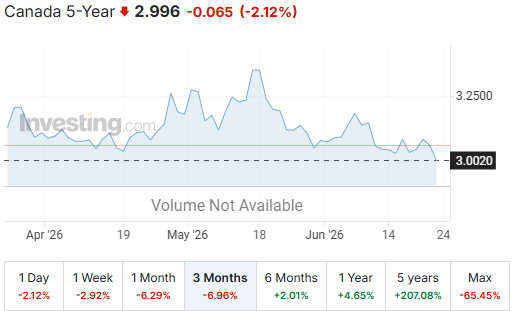
Fixed mortgage rates have begun to drop, given lower Government of Canada Bond yields, which are currently trading close to 3% for the 5-year.
As the Iranian war de escalates and shipments resume through the Straight of Hormuz, oil prices have plummeted to the $70 per barrel range. This reduces inflationary pressures for the remainder of 2026 and also reduces the likelihood of Bank of Canada (and US Federal Reserve) interest rate hikes to combat inflation. Accordingly, Bond Yields have drifted lower, and this is leading to reduced fixed mortgage rate pressure
Specifically, if Bond Yields remain at current levels, the mortgage rate forecast is for 5 y fixed rates in the 3.89 – 4.09% range within the next month. There’s a saying in the mortgage industry about fixed rates: ‘Rates go up like a rocket, and float down like a feather’. In other words, although Bond Yield are currently supportive of lower fixed rates, it takes the banks time to adjust their mortgage rate pricing models.
Sticky US Inflation Resulting in a Mortgage Rate Floor
Although inflation appears well contained in Canada, it is stickier in the US. This will keep US bond yields higher, which will keep upward pressure on Canadian yields.
Given this, although Canada is experiencing a stronger deflationary impulse and lower bond yields than in the US, US yields still influence the Canadian market. So we likely won’t see a 0.25%+ drop in fixed rates in the near term.
If the US can avoid a Fed hike in 2026 and 2027, that would be a bonus.
Smith Manoeuvre Tip of the Week
One of the key questions with the Smith Manoeuvre is what to invest in. We won’t be recommending any specific security here or providing investment advice, but we can generally suggest investment approaches that fit well with the strategy.
Dividend investing is popular for the cash flows these stocks provide. There are several reasons investors like dividend stocks, from more stable busienss profiles to DRIP programs that allow for additional share purchases. For the Smith Manoeuvre, there is a view that the dividend can cover the interest on the HELOC associated with the strategy.
This, in theory, sounds reasonable; however, a well-operating Smith Manoeuvre will not require this dividend payment to cover the interest. Instead, the HELOC itself ‘re capitalizes’ the interest – so no additional income, including dividend income, is typically required to fund the strategy. Add to this that dividend income increases annual income tax, and is less efficient than capital gains tax. There are dividend stock index ETFs, however, these ETFs produce a lower annual return than more traditional indexes, such as the TSX composite or S&P 500.
Given the greater returns seen in more traditional index ETFs or all-in-one ETFs such as XEQT or VEQT, and the income-tax efficiency of capital gains relative to dividend investing, there is a strong case that a simple all-in-one ETF can deliver solid returns to reliably propel the strategy over the long term.
