
Mortgage Rate Forecast Canada 2026 – 2027
By Brent Richardson, Mortgage Broker & Certified Financial Planner (CFP®)
The decisions Canadians make on their mortgage in 2026 largely depend on the mortgage rate forecast. It’s a decision that will affect homeowners for several years to come and could save thousands of dollars in mortgage interest.
Here we’ll look at where mortgage rates are likely headed, based on a current July 2026 review of real time economic insights, and years of in-depth, ‘ground level’ mortgage market study, with over 1,900 mortgages personally closed.
We will review these 3 predictions:
- Short term (2026-2027) forecast: In the next year, fixed and variable mortgage rates will likely drift lower to the mid – high 3% raange.
- Long term (2027 – 2030) forecast: Historical context indicates mortgage rates will likely gravitate lower, back toward a historical trend in the 3% range.
- What mortgage to take to maximize your benefit from these predictions.
Page Last Updated: July 5, 2026
Short Term Mortgage Rate Forecast
As of July 5, 2026, the market consensus on the mortgage rate forecast in Canada is for the Central Bank to hold the overnight interest rate at 2.25% at its July 15, 2026 meeting and will continue to hold through the summer.
The Mortgage Interest Rate ‘Crystal Ball’: Bond Yields
The main tool we have when reading the current mortgage rate market is the Government of Canada Bond Yield. A Canadian bond is a government debt security that pays investors a return. The ‘%’ based return is called the ‘yield’ and is considered one of the safest investments because the Government would have to go bankrupt for it not to pay its investors.
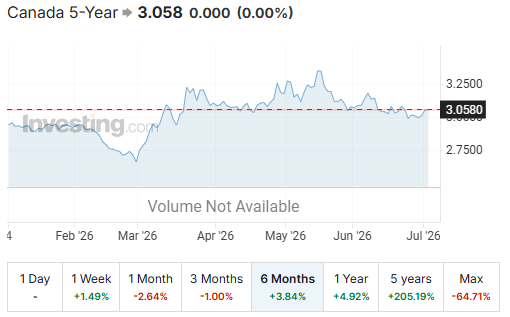
The Government of Canada 5 year Bond Yield factors in all known economic data on a day to day, and even a minute to minute basis. Simply put, when bond traders expect the Central Bank of Canada to raise rates, bond yields rise. On the other hand, when the Bond market expects the central bank rate to decrease, yields drop. In other words, the Bond yield trades or is priced in anticipation of where the Central Bank of Canada rates will move.
Bond traders and the Bank of Canada are essentially asking the same related questions: Will inflation rise or fall? Is the economy strengthening or weakening?
Although it’s primarily the Bank of Canada that influences the economy through its interest rate decisions, Bond traders understand how the Bank of Canada will need to act, based on up-to-the-minute economic data.
It helps to seperate mortgage rate predictions into two categories: Fixed and Variable
When we look at the 5 Year Bond Yield, this is highly correlated with the 5 year fixed mortgage rate. It’s the same idea as the 3 Year Bond Yield correlation with a 3-year fixed mortgage rate. When these bond yields move down or up, we can expect:
(1) Very near term changes in rate pressure for these fixed rates
(2) An indication of where the Bank of Canada Overnight rate will be over these periods
Fixed Mortgage Rate Forecasting Tools
The 5 Year Bond Yield has been trending downwards by about 0.20% over the past month. This tells us there is currently downward pressure on 5-year fixed mortgage rates.
Fixed mortgage rates are generally priced about 1% higher than bonds (given the riskier nature of mortgages vs. government bonds); however, this ‘spread’ can change over time, and the key point here is that fixed mortgage rates and bond yields tend to move together – they’re highly correlated.
Variable Mortgage Rate Forecasting Tools
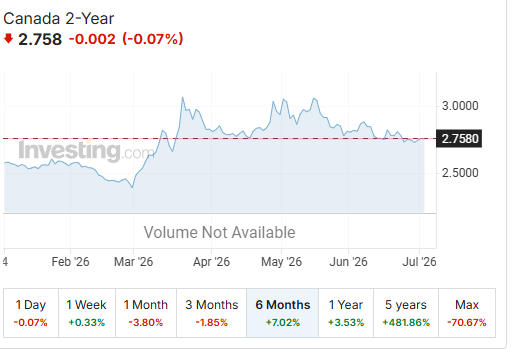
Variable rates are more closely associated with short-term bond yields, such as the 2-year Government of Canada Bond Yield. More specifically, the 2-year bond yield is highly correlated with the average Bank of Canada Rate over the next 2 years. If the 2 year Yield is higher than the current Bank of Canada Overnight rate, this tells us that financial markets are pricing in hikes.
In addition to reviewing Bond Yields for short-term Bank of Canada and Variable mortgage rate moves, there are other, even more specific measurements, such as currency and rate swaps or ‘CORRA rates’, that are beyond the scope of this article. Bond yield information is readily available and provides a good indication of short term mortgage interest rate forecasts.
What Bond Yields are Currently Predicting for Canadian Interest Rates in 2026 – 2027
Currently, in 2026, Bond Yields are forecasting:
- Slight downward pressure on fixed mortgage rates to the 3.84% – 4.14% range
- Variable mortgage rates to hold through the summer months and moving into 2027.
As of July 5, 2026, the charts below reflect these predictions. However, there are some pretty big caveats here that should be understood and will be explained below.
5 Year Government of Canada Bond Yield
Correlated with Fixed Mortgage Rate Movement
2 Year Government of Canada Bond Yield
Correlated with Variable Mortgage Rate Movement
The Iran War and Mortgage Rate Projections
As the war in Iran de-escalates, we can see that the bond yields in the charts above are trending downwards.
This is because oil prices have slid from over $100 down to under $70. Oil prices affect so many areas of the economy, from energy to manufacturing to transportation, higher oil prices lead to higher consumer costs or in other words, inflation.
In inflationary environments, interest rates – including mortgage rates will move higher to reduce inflation.
It’s likely that oil prices will continue to find their way lower medium term – long term – there is an abundance of oil, and work has already started finding alternative delivery routes and pipelines. This will continue to pressure bond yields and, therefore, mortgage rates downwards.
There are other significant, short-term trends that will add downward pressure on fixed mortgage rates, which we will review next.
Economic Undercurrents Pushing Down Interest Rates
Economic Stagnation in Canada
It’s no secret to most Canadians that the economy is weakening, and Canadians are feeling the pinch. Employment levels are trending downward as US trade threats are causing large manufacturers, especially in the Ontario Auto industry, to exit. GDP/economic growth continues to be revised downwards, and there is no real, fundamental catalyst in sight to spur economic growth in Canada.
A deteriorating economy adds a fundamentally negative pressure on interest rates. When the short-term effects of high oil prices subside, the fundamental weakness will persist and is likely to add downward pressure on rates.
Technology Deflation Trends
One of the biggest forces in the Canadian and Global economy is technological. Ultimately, new technology increases economic productivity. This means fewer employees can get more work done. Fewer resources are needed for improved results. This has the opposite effect on the economy of inflation: technological advancements are deflationary because they allow goods and services to be produced at lower cost.
As the months pass by and the effects of AI embed themselves into the economy, the deflationary effects will be slow at first – but will almost certainly pick up speed. This is a long-term economic structural trend that will put negative pressure on mortgage interest rates.
More on Short Term Mortgage Data
It’s important to note that the bond yield and short-term mortgage rate data emphasize current, hard numbers. For example, if inflation is currently seen as increasing, this data will be projected as a longer-term trend over several years.
However, the longer the time horizon over which current data is projected, the more likely it is that changes will occur in this data.
So even though there are some projections that, 2 years out, interest rates will be higher, the point is that it’s impossible to predict what the hard data will be at that time. This is why, in this article, we have taken a broader, historical approach and also applied more fundamental economic trends to help determine the likelihood of the mortgage rate forecast.
Long Term Mortgage Rate Forecast
Mortgage rates in Canada are forecast to gravitate towards historical lows over the long term (5+ years).
To help determine the mortgage rate forecast, one of the best perspectives we have is historical.
During the Great Recession of 2008, the financial system and the economy as a whole required bailouts and stimulus measures on a scale never before seen, just to keep running. Thankfully, the stimulus did its job, and the economy rebounded and got back on track. However, between 2008 – 2019, for over 10 years, there was very low or stagnant GDP growth, and interest rates remained low accordingly.
Then, during the COVID pandemic, in 2020 – 2022, we witnessed another massive economic bailout. This time, the stimulus was far greater than in 2008, accounting for over 40% of the dollars ever created between 2020 and 2022.
While this ‘money printing’ can be inflationary, and this will be addressed below, the point here is that historically, when a massive new government and private debt are layered upon already massive debt, this can perpetuate dependence on yet ever cheaper debt to stimulate the economy long term. It can lead to long term economic stagnation and, importantly, to a ‘magnifying effect’ of increased rates.
More specifically, with over 7 times more debt in the economy today, adjusted to inflation, than in the 1980s and early 90s, a single 0.25% rate increase makes an approximately 7 times bigger impact than it did when debt levels were a fraction of current levels. Accordingly, there is significant long term pressure for rates to remain low.
From another historical perspective, when rates increased in the 1980s from a base of 10% to a high of 20%, this represented a 2x increase. However, when rates increased in 2022 – 2023 from a base point 0.25% to 5%, this represented a 20x rate increase, which had a much greater shock to the economy.
In fact, even though Canada saw its inflation peak at 8.1% in June 2022, the sudden Bank of Canada increase to just 5% led to rapid disinflation back to the 2% range within approximately 1 year. If the Bank of Canada had left rates at 5%, Canada would currently be in a deflationary, highly depressed economic environment. To prevent this, Bank of Canada cut its overnight rate to 2.25% where it currently sits.
This recent historical case study confirms that it does not take a major interest rate hike to drive economic activity/ GDP lower, and moreover, perpetually lower rates are required to stimulate economic growth. Overall, when we zoom out, this is highly indicative of lower long-term interest rates.
We will see in the next section, that short term inflationary trends are adding upward pressure to mortgage rates. But economic forces and an abundance of oil supply will eventually reduce the short-term inflation trend and, along with other significant factors, allow a longer-term trend toward lower mortgage interest rates.
Strategies to position your mortgage for reduced risk and interest rate savings
In our fast-changing economic environment, it can be difficult to determine an approach that will result in interest savings and protect against short-term effects of inflation and mortgage rate fluctuations. But based on years of experience, here is our recommended approach.
If your tolerance for market volatility or ‘risk’ is higher, consider a variable mortgage rate.
Variable mortgage rates are currently about 0.50% lower than 5 year fixed mortgage rates. In other words, the variable would need to increase by approxemately 0.50% to match the current 5-year fixed rates.
So by taking a variable rate, you save in the short term. If rates increase by 0.50%, you would be in line with the current 5-year fixed rates.
But what if the Bank of Canada hikes rates by 0.75% or even 1%? This would surely put you above the current 5-year fixed rates.
However, a risk mitigation strategy for the variable rate is to use pre payment privilages with the (for example, 15% or 20% annual prepayment) to increase your variable rate payment to the equivalent of what the 5 year fixed mortgage rate would be (if instead you selected a 5 year fixed rate). Making additional prepayments on the lower variable rate accelerates mortgage payoff when the variable rate is lower than the fixed rate. Each additional payment you make builds a ‘war chest’ against future rate increases.
If rates were to increase by 0.50%, you could simply remove the extra mortgage pre payment and you’d be in line with the 5 year fixed mortgage rate. However, you will likely have spent some time prepaying your mortgage and getting ahead on the amortization. This means that even if the Bank of Canada hikes rates even higher, you would not be behind until breaking even with the additional payments you made while rates were lower.
Then comes the question of how long rates would be higher, especially given a generally weakening Canadian economy. Also, if oil prices drop, this would remove upward rate pressure.
So with this variable mortgage rate strategy, you would be proactively mitigating upward rate risk by getting ahead with your mortgage principal payments, while also leaving yourself open for longer term foundational downward rate pressures that will become more apparent once the Iran war subsides.
If you’re not as comfortable with a variable rate, a 3-year fixed rate offers a similar approach. Currently 3 year fixed rates are about 0.20% lower than 5 year fixed rates. So you could save for 3 years vs a 5-year fixed rate, with the certainty of a predictable rate for 3 years. After 3 years, the effects of currently high oil prices are likely to have subsided and you would have optionality for a lower mortgage rate. Or if rates were to drop within the final 1.5 years of a 3-year fixed rate term, there is a good chance (depending on the current interest rates) you can break the 3-year fixed mortgage with a 3-month interest penalty and lock in a lower rate if market rates have dropped.
What about a 5 year fixed rate?
The 5 year fixed rate is still the best choice for many. Ultimately, nothing in the economy or with interest rates is guaranteed, so having mortgage rate certainty for a full 5 years can be highly valuable. How much price can you put on a good night’s sleep? That’s up to each individual. Moreover, 5 years is not too long – for many, it’s not locking in for the full mortgage amortization.
Given this, even a 5-year fixed rate can renew into a lower rate as longer-term rate trends shift, while providing more certainty in the medium term.
Connect with us at Altrua Financial for a free, no obligation consultation and a personalized approach to your best mortgage strategy
Thanks for reading
About Brent Richardson
Mortgage Broker | Founder Altrua Financial Inc | Certified Financial Planner (CFP)
Brent has helped thousands of Canadians optimize their mortgage and investment strategies. With over 1,900 mortgages closed and nearly two decades of experience at the intersection of mortgages and financial planning, Brent combines real-world data and insight for clients who want clarity in a changing market.