
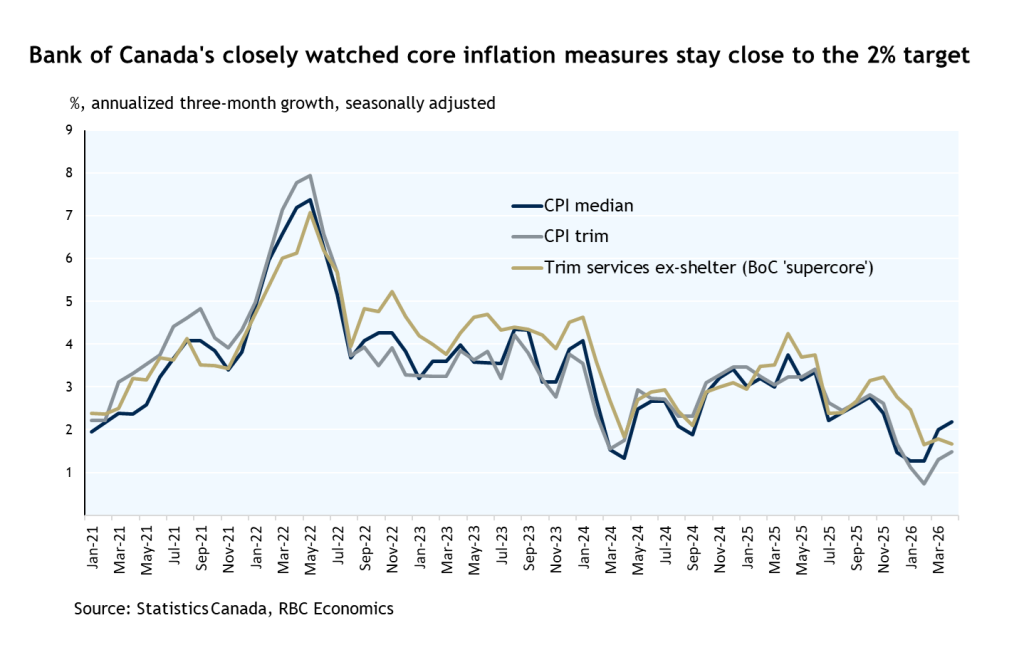
As gas prices soar, Canadian CPI/inflation rose 2.8% in April, up 0.04% from 2.4% in March.
However, the market consensus was that inflation would increase by 3.1% in April, so the 2.8% increase was a welcome surprise. Moreover, excluding gas prices, inflation was 2.0% in April, down from 2.2%.
Overall, this was a relatively soft inflation reading, especially given the ‘trickle down’ effects of high oil/gas prices across the economy.
The main reason for the weaker-than-expected inflation is due to a generally softening economy in Canada. Consumers are strained across the country, so even though prices may be rising, demand for goods and services is not strong enough to push prices up as much or as quickly as expected.
According to RBC Economics, ‘the softer economy gives the Bank of Canada room to look through short term price volatility, as high oil/gas prices are unlikely to re-ignite broader inflation near term’.
RBC maintains that the soft economy will keep inflation at bay, and the Bank of Canada is likely to remain on the sidelines in 2026. Also, the Iranian war could end at any time, putting downward pressure on oil/gas prices and inflation.
Inflation’s Effects on the Fixed and Variable Mortgage Rate Forecast
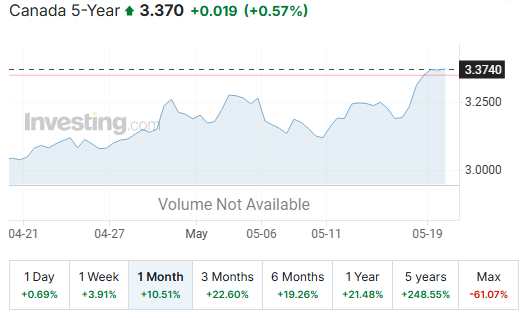
Unlike some of the major banks, financial markets/bond yields are pricing in one Bank of Canada rate hike by the December 2026 meeting.
Bond yields are mostly flat on the day but have been increasing steadily over the past month. This is affecting the mortgage rate forecast by adding upward pressure on fixed mortgage rates, which have increased by about 0.20% over the past month. At these levels, bond yields could push fixed mortgage rates higher by 0.05 – 0.10% and more so if yields continue to increase.
Although the Canadian economy isn’t likely to see much higher inflation soon, the US economy is under more inflationary pressure, and US bond/treasury yields are helping push Canadian yields higher.
Overall, this inflation trend is likely to continue to exert near-term upward pressure on fixed mortgage rates in Canada. If youre seeking a fixed mortgage rate in 2026, be sure to get a rate hold. However, medium term, perhaps in 2027, as the Iranian war is likely to de-escalate and economies soften, bond yields should drop, removing fixed rate pressure. At some point, we may also see a Bank of Canada rate cut, which would also send variable mortgage rates down.
Smith Maneuver Tip of the Week
In many cases, Canadian homeowners see financial benefits of $200,000 to $300,000, or even more, from the Smith Maneuver by paying down their non-tax-deductible mortgage faster and saving on income taxes.
Importantly, the Smith Maneuver is a self-contained financial strategy when operating normally. This means you dont need to draw on additional cash flow or make additional mortgage payments to reap the benefits. The borrower just continues to make their regular mortgage payment.
Although there is HELOC interest that accumulates as one aspect of the strategy, the HELOC interest is paid by the HELOC itself – not out of pocket. This is known as ‘re capitalizing’ of the HELOC interest. The calculations and projections shown on the official Smith Maneuver calculator incorporate this recapture of HELOC interest in the results.
The only time when the Smith Maneuver could require higher payments is if interest rates increase significantly, over 2.5%. However, this does not appear to be a significant threat in Canada’s softer economy, with mortgage rates currently not expected to increase substantially in the short term and are likely to see downward pressure in the medium- to longer-term.
For more questions on the Smith Maneuver, connect with us today.
